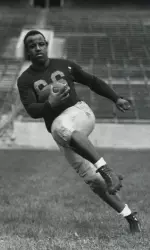
Claude "Buddy" Young
February 13, 2008 | General
Feb. 13, 2008
At Englewood High School in Chicago, Ill., his football career was nearly derailed because the coach thought his five foot-four inch frame was too small, a perceived obstacle he would hear about many times in his life. After transferring to Wendell Phillips High School, Claude "Buddy" Young proved his size was just right scoring four touchdowns against his former coach and Englewood teammates.

 |
|
Young accepted a scholarship offer to play football at the University of Illinois for head coach Ray Eliot. With his enrollment, he became the first African American in forty years to put on the Orange and Blue for the Illini football team.
Graduating a semester early from high school, Young's Illinois legend began on the track in the spring of 1944. Winning the NCAA championship in the 100m and tying the world record in the 60m with a time of 6.1 seconds.
Already known for his speed, Young made an immediate impact on the gridiron his freshman season. Earning the nickname "Bronze Bullet," he helped the Illini to a 5-4-1 record, and racking up 842 yards and 13 touchdowns, tying former Illini great Red Grange's Big Ten single-season record. He received All-America honors from publications around the nation for his performance.
So, what made Buddy Young such an exceptional runner in only his first season? "Buddy hit the line extremely hard," News-Gazette columnist Loren Tate said. "He had a solid frame and could make two or three tacklers miss."
High expectations for his sophomore season were put on hold when the Navy drafted him early in 1945. During his year of service, Young played for the Navy's Bluejacket football squad in Fleet City, Calif., where he excited a new group of fans on the West Coast. At the league's championship game in Los Angeles he scored three touchdowns including two kick returns for scores. Legendary comedian Bob Hope said of Buddy after the game, "I'd heard of black magic...now I've seen it!"
After gaining so much exposure in the Navy, Eliot had to re-recruit his star running back away from West Coast schools. Fortunately for the Illini, the two had formed a close relationship and Young returned to Champaign-Urbana.
In what would turn out to be one of the greatest seasons in Illinois' history, Mr. 5-by-5 shared carries with another talented back, Jules Rykovich. However, the star of the team was apparent.
"Buddy Young was the fan favorite," Tate said. "He had a flamboyant running style that kept fans' attention because he could break one for a touchdown at any time." The Illini went 7 -2 and earned a trip to the 1947 Rose Bowl against UCLA.
To many the Illini didn't stand a chance against the undefeated Bruins. The press clamored for an Army-UCLA match up instead. Eliot used the disrespect as motivation and the Illini proved the naysayers wrong. After giving up an early touchdown, the Orange and Blue took control of the game by scoring 21 unanswered points. Overall, seven Illini scored in the 45-14 victory. Young ran for 110 yards on 20 carries and scored two touchdowns, the first ever scored by an African American in the Rose Bowl. He was named co-player of the game along with fellow running back Rykovich.
Young's Rose Bowl performance would prove to be his last in an Illinois uniform. Citing the need to provide for his wife and young child, he signed a contract to play professional football for the New York Yankees of the All-American Conference (AAC).
Racial prejudice was more severe in the professional ranks with only a handful of African Americans on other professional teams. One incident Young often discussed was a game against the Baltimore Colts during his rookie season with the Yankees. A crowd of Colts fans covered their faces with black shoe polish and berated the running back with racial epithets outside of the locker room. Ironically, the most remarkable part of the story came in 1956 when the Colts retired his number 22.
After the AAC folded, Young went on to play for the Dallas Texans and Baltimore Colts of the National Football League (NFL). He totaled 9,419 yards and scored 44 touchdowns in nine professional seasons.
After his playing career, Young worked for the Baltimore Colts until 1964 when he broke another racial barrier in sports. NFL Commissioner Pete Rozelle hired Young to become the first African American executive of a major sports league. His time with the NFL was spent to better job prospects for players after their playing careers. Eventually reaching the position of director of player relations, Young helped countless athletes attain positions that kept former players on a positive path.
Claude "Buddy" Young passed away in a single car accident in 1983. He never forgot his roots often returning to his alma mater.
"The name Buddy Young has been synonymous with the University of Illinois for over a thirty-five year period," Athletic Director Neale Stoner said at the time of his death. "His loyalty and generosity to the Athletic Association would rival any former Fighting Illini."
Leaving behind a proud legacy of breaking barriers, helping others and living life to its fullest Young was laid to rest in his hometown of Chicago,Ill. The University of Illinois, the game of football and the citizens of the United States will always remember the name Buddy Young with fond memories.